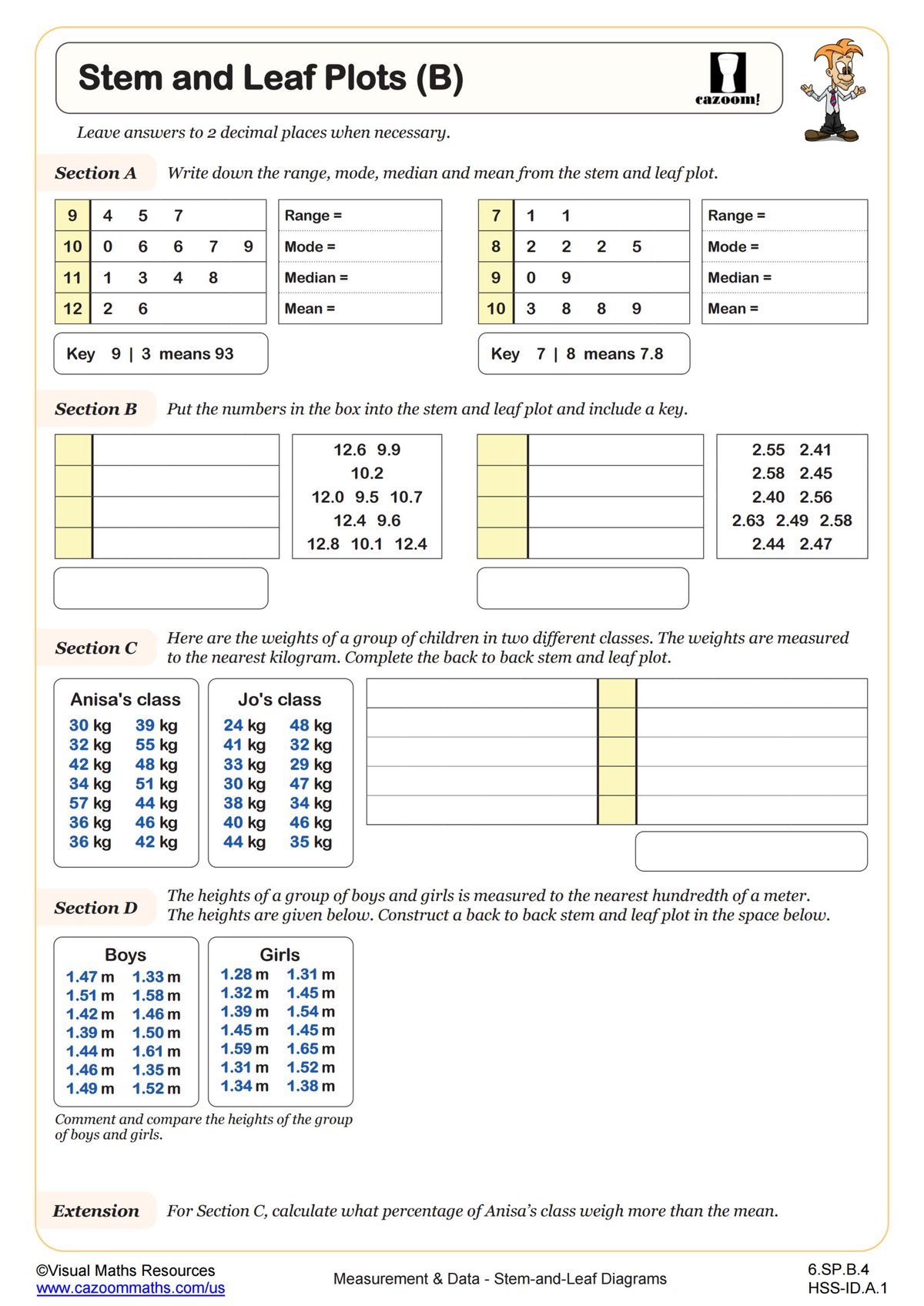
When you're faced with a seemingly jumbled list of numbers, how do you quickly make sense of them? How do you spot trends, understand spread, and identify unusual data points without getting lost in the weeds? That's precisely where interpreting data from stem and leaf plots shines. These clever visualizations offer a unique advantage: they display the actual numerical data while simultaneously giving you a powerful graphical representation of its distribution. Think of them as a statistical x-ray, revealing the skeletal structure of your dataset.
At a Glance: Why Stem and Leaf Plots Are Your Data Detective Toolkit
- Raw Data at Your Fingertips: Unlike histograms, you see every single data point, not just aggregated bars.
- Instant Trend Spotting: Quickly identify central tendencies, data spread, and where values cluster.
- Outlier Alert: Extreme values practically jump off the page, making anomalies easy to spot.
- Side-by-Side Comparisons: Effortlessly compare two datasets to understand differences and similarities.
- Easy Statistic Calculation: Quickly pinpoint the median, mode, and range directly from the plot.
What Makes a Stem and Leaf Plot So Powerful?
Imagine you have a list of twenty-five student test scores: 72, 85, 91, 78, 65, 88, 70, 95, 82, 79, 68, 81, 75, 90, 83, 76, 60, 87, 73, 92, 80, 77, 69, 84, 74. Just looking at this list, can you tell what the average score is? Or what score appeared most often? Probably not easily.
This is where stem and leaf plots come in. They’re a brilliant hybrid—part table, part graph—that organize numerical data by splitting each value into a "stem" (typically the leading digit or digits) and a "leaf" (the trailing digit). This simple act transforms a disorganized list into an insightful visual.
You can view these plots as a special kind of histogram where the data values themselves form the "bars." The 'bins' are naturally separated by place value, meaning many of the interpretation skills you'd use for a histogram, like observing peaks and spread, apply directly here. The key difference? The stem and leaf plot never loses the individual data values, offering a richer, more detailed view.
Decoding the Numbers: How to Read a Stem and Leaf Plot
Before you can interpret, you need to know how to read one. It’s simpler than you might think.
Each plot has two main columns:
- The stem column on the left usually represents the tens place, hundreds place, or even a decimal's whole number.
- The leaf column on the right lists the ones place, the tenths place, or the next significant digit for each data point.
Crucially, every stem and leaf plot includes a key. This key tells you what the stem and leaf represent.
Example:
Let's use our test scores: 60, 65, 68, 69, 70, 72, 73, 74, 75, 76, 77, 78, 79, 80, 81, 82, 83, 84, 85, 87, 88, 90, 91, 92, 95.
Here's how it would look:
Stem | Leaf
-----|-----
6 | 0 5 8 9
7 | 0 2 3 4 5 6 7 8 9
8 | 0 1 2 3 4 5 7 8
9 | 0 1 2 5
Key: 6 | 0 = 60
To reconstruct the data points, you combine each stem with its leaves: - Stem '6' with leaves '0, 5, 8, 9' gives you 60, 65, 68, 69.
- Stem '7' with leaves '0, 2, 3, 4, 5, 6, 7, 8, 9' gives you 70, 72, 73, 74, 75, 76, 77, 78, 79.
- And so on.
The beauty is that the data is already sorted in ascending order for you, which makes subsequent analysis much easier. If you're looking to generate a stem and leaf plot yourself, our tool can help you quickly visualize your own data.
Uncovering the Data's Story: Key Characteristics to Interpret
Once you can read the plot, the real fun—interpretation—begins. You’re looking for patterns, irregularities, and key statistical measures.
Range: The Full Span of Your Data
The range is the difference between the greatest and least values in your dataset. It gives you a quick sense of the data's spread.
- How to find it: Identify the smallest data point (first leaf of the lowest stem) and the largest data point (last leaf of the highest stem). Subtract the minimum from the maximum.
- In our example: Max = 95, Min = 60. Range = 95 - 60 = 35.
- What it tells you: A large range indicates significant variability in the data, meaning values are spread far apart. A small range suggests data points are relatively close together.
- A Red Flag: If you observe a very large range but notice only a few data values per stem, it might suggest the data is quite sparse for the chosen stem unit, or perhaps there are some extreme outliers that deserve closer investigation.
Shape: Visualizing the Distribution
The overall shape of your stem and leaf plot is your first clue to understanding the data's distribution. Think of tilting the plot on its side, with the stems at the bottom, and observing the "bars" formed by the leaves.
Bell-Shaped (Symmetric)
- What it looks like: Data clusters around a central value, with fewer data points extending towards the extremes on either side. It often resembles a bell curve.
- What it means: This shape suggests that most values are concentrated around the median (and often the mean and mode, which will be very close together). It implies a natural distribution where average values are most common. Think of human heights or standardized test scores; most people fall in the middle, with fewer at the very tall or very short ends.
Uniform
- What it looks like: Each stem has roughly the same number of leaves, creating a relatively flat, rectangular shape.
- What it means: A uniform distribution implies that data values are spread fairly consistently across the entire range, without significant peaks or valleys. Every value has an approximately equal chance of occurring.
- Consider this: While it shows consistency, a very uniform plot might be less useful for identifying clear trends or dominant values. If you encounter a perfectly uniform plot, you might consider adjusting the place value of your stem (e.g., using smaller increments for the stem) to see if more detail emerges.
Skewed: Spotting the Outliers
Skewness indicates that the data is not symmetrical and has a "tail" extending to one side, usually due to the presence of outliers.
- Skewed Down (Left-Skew):
- What it looks like: The "tail" of the data points extends to the left (lower values). Most of the data is clustered towards the higher values.
- What it means: This indicates that outliers are predominantly lesser than the main cluster of data. When data is left-skewed, the mean will generally be less than the median, which in turn will be less than the mode. The mode represents the most frequent value, which sits at the peak of the cluster, while the mean gets "pulled down" by the lower outliers.
- Analogy: Imagine a classroom where most students scored high, but a few scored very low. Those low scores pull the average (mean) down, making it lower than the typical (median) or most common (mode) score.
- Skewed Up (Right-Skew):
- What it looks like: The "tail" of the data points extends to the right (higher values). Most of the data is clustered towards the lower values.
- What it means: Here, the outliers are mostly greater than the mode. For right-skewed data, the mode will be smaller than the median, which in turn will be smaller than the mean. The higher outliers "pull" the mean towards the larger values.
- Analogy: Consider household incomes. Most people earn a moderate income, but a few individuals earn extremely high incomes. Those high incomes pull the average (mean) up, making it higher than the typical (median) or most common (mode) income.
Understanding skew is vital because it reveals how outliers influence central tendency measures, especially the mean.
Extracting Insights: Describing Your Data from a Stem Plot
Once you've grasped the characteristics, you can craft a comprehensive description of your data. Think like a storyteller, guiding your audience through what the plot reveals.
- Observe the General Shape: What's the overall distribution? Is it bell-shaped, uniform, or skewed? Where does the data appear to be concentrated?
- Identify Extremes and Central Tendency: What are the maximum and minimum values? Where is the middle (median)? What value(s) appear most often (mode)?
- Evaluate for Outliers and Spread: Are there any data points significantly far from the main cluster? How spread out are the values? Is the data tightly grouped or widely dispersed?
- Relate Median and Mode (and Infer Mean): How do these measures interact? Does their relationship suggest any skew?
- State the Context: What does this data represent? (e.g., "The test scores were generally high," or "Most of the patients recovered quickly.") This helps ground your interpretation in the real world.
For example, describing our test scores: "The distribution of test scores is roughly bell-shaped, indicating that most students scored in the 70s and 80s. The lowest score was 60, and the highest was 95, giving a range of 35 points. There are no obvious extreme outliers, and the data is fairly concentrated around the mid-70s to mid-80s, suggesting a generally good performance across the class."
Beyond the Visuals: Calculating Key Statistics
While the visual aspects are powerful, stem and leaf plots also make calculating precise statistics straightforward.
- Count (n): This is simply the total number of data points. To find it, count every single leaf in the plot.
- Our example: There are 4 leaves in the 6-stem, 9 in the 7-stem, 8 in the 8-stem, and 4 in the 9-stem. Total leaves = 4 + 9 + 8 + 4 = 25 data points (n=25).
- Mode: The mode is the value that appears most frequently in your dataset. Since the leaves are organized and ordered, spotting repeated values is easy.
- Our example: Looking at the leaves, no single value appears more than once in this specific dataset (e.g., no '6|5 5'). If '8|2 2 2' appeared, then 82 would be the mode. If multiple values appear with the same highest frequency, all are modes.
- Median: The median is the middle value when the data is arranged in order. Stem and leaf plots present data in sorted order, making this calculation quick.
- If 'n' is odd: The median is the single middle value. The position of the median is (n+1)/2. For n=25, the median is at the (25+1)/2 = 13th position. Count 13 leaves from the top or bottom to find it.
- Our example: Counting 13 leaves: 60, 65, 68, 69, 70, 72, 73, 74, 75, 76, 77, 78, 79. The 13th value is 79. So, the median score is 79.
- If 'n' is even: The median is the average of the two middle values. The positions are n/2 and (n/2)+1.
- Example: If n=24, the median would be the average of the 12th and 13th values.
- Range: (As discussed) Max value - Min value.
Comparing Apples to Oranges (or Apples to Apples): Back-to-Back Stem Plots
Sometimes, you need to compare two related datasets. Perhaps you want to see how two different classes performed on the same test, or how patient recovery times differ with two different treatments. This is where back-to-back stem plots become incredibly useful.
A back-to-back plot shares a common stem in the center, with leaves extending to the left for one dataset and to the right for the other.
Example: Test Scores for Class A vs. Class B
| Class A | Stem | Class B |
|---|---|---|
| 9 8 5 | 6 | 0 2 5 |
| 7 5 3 2 1 0 | 7 | 1 3 4 6 8 |
| 8 7 6 4 3 2 1 0 | 8 | 0 2 5 6 7 8 9 |
| 5 2 | 9 | 0 1 3 5 |
| Key: 6 | 0 = 60 (Class B) | |
| 9 | 6 = 69 (Class A) | |
| What to compare: |
- Shape: Do both classes show a similar distribution (bell-shaped, skewed)? Class B seems to be slightly skewed to the left (higher scores), while Class A looks more symmetrical.
- Frequency Distributions: Which stem has more leaves for each class? Class A has more students in the 70s and 80s, while Class B has a significant cluster in the 80s and 90s.
- Consistency: Is one class's data more spread out (less consistent) than the other? Class A has a wider range of scores (65-95) than Class B (60-95), but Class B's range is actually the same, so no clear difference here. However, Class B has a higher concentration of scores at the upper end.
- Specific High/Low Values: Are there any notable differences in the maximum or minimum scores?
- Blank Entries: A blank entry in a stem's leaf area simply means there are no data points within that range for that particular dataset. For instance, if Class A had no scores in the 60s, its '6' stem row would be empty.
By visualizing both datasets side-by-side, you can make immediate, powerful comparisons that would be much harder with just lists of numbers.
Common Questions and Expert Tips
Even with the clarity of stem and leaf plots, a few questions often arise during interpretation.
Can I use decimals or larger numbers in my stem and leaf plot?
Absolutely! The key is what defines the stem and what defines the leaf.
- Decimals: If your data is 2.4, 2.9, 3.1, you might set the stem as the whole number and the leaf as the tenths place. The key would be "2 | 4 = 2.4".
- Larger Numbers: For numbers like 240, 245, 290, the stem could be the hundreds place, and the leaf the tens place (e.g., '2' stem, '4' leaf for 240, '9' leaf for 290). The key would be "2 | 4 = 240". Always ensure your key makes it perfectly clear how to read the values.
What if I have too many leaves on one stem, or too few?
Sometimes, a single stem might have a very long row of leaves, making it hard to read. Conversely, some stems might be empty.
- Splitting Stems: If a stem is overloaded, you can "split" it. For example, '2' could be split into '2a' (for leaves 0-4) and '2b' (for leaves 5-9). This expands the plot and provides more detail on the distribution within that specific range.
- Empty Stems: Empty stems are normal and simply indicate that there's no data in that range. Don't omit them unless they're at the very beginning or end of your entire dataset, as they help maintain the visual structure of your distribution.
How do I know if a value is a true outlier?
Visually, an outlier is a data point that stands noticeably apart from the main cluster of data, often appearing as a single leaf on a stem far above or below the others. For a more formal definition, statisticians often use methods like the Interquartile Range (IQR) rule, which identifies values beyond 1.5 times the IQR from the first or third quartile. While a stem and leaf plot helps you spot potential outliers, you might need further statistical analysis to confirm them.
Expert Tip: Always Include a Key!
This cannot be stressed enough. Without a clear key, your stem and leaf plot is uninterpretable. It's the essential guide that tells your audience how to translate the visual back into meaningful numbers.
Moving Forward: What Your Stem Plot Tells You Next
Mastering the art of interpreting data from stem and leaf plots elevates you from merely looking at numbers to truly understanding the stories they tell. You gain a powerful ability to dissect a dataset, identify its core characteristics, spot anomalies, and even compare it against others, all while retaining the granular detail of the original data.
These insights are invaluable, whether you're a student analyzing survey results, a business professional evaluating sales figures, or a researcher examining experimental outcomes. The patterns and distributions you uncover through stem and leaf plots can inform decisions, highlight areas needing attention, and lay the groundwork for more advanced statistical analysis. So, grab your data, plot it out, and start revealing its trends—the story is waiting to be told.